
यदि कोई छात्र एक या अधिक बेल्ट को छोड़ देता है, तो शेष बेल्ट की राशि को भी बेल्ट राशि में जोड़ा जाएगा और भुगतान किया जाएगा।
|
in result 50% marks students fail |
|
70% Mark Improve practice |
|
80% Mark Good performance |
|
90% to 100% Mark Best performance |
|
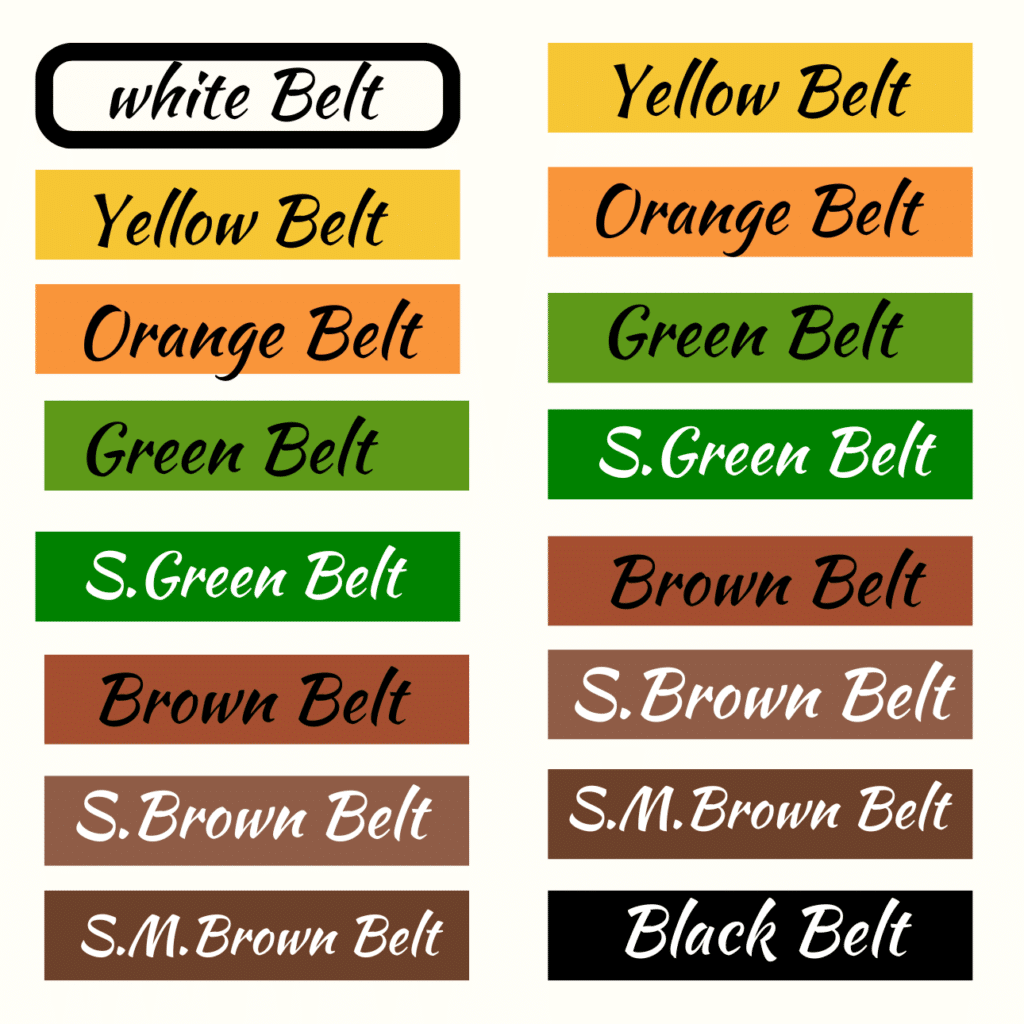
Yellow Belt |
1) 400 Punches |
|
Orange Belt |
1) 600 Punches |
|
Green Belt |
1) 800 Punches |
|
S.Green Belt |
1) 1000 Punches |
|
Brown Belt |
1) 2000 Punches |
|
S.Brown Belt |
1) 2500 Punches |
|
S.M.Brown Belt |
1) 2000 Punches |
|
Black Belt |
1) 3000 Punches,1000 Stamina Punches, |
|
HAJME |
Begin. A command given to start a given drill, Kata, or Kumite. |
|
HEIKO DACHI |
A natural stance. Feet positioned about one shoulder width apart, with feet pointed straight forward. Some Kata begin from this position. |
|
ZUKI |
Punch |
|
GERI |
Kick |
|
DAN |
Degree. Black Belt rank |
|
DOJO |
The place where we practice Karate |
|
KARATE GI |
Karate Uniform |
|
UKE |
Block |
|
KUMITE |
Fight |
|
Tatami |
karate mats ,tatami size 88 meter 1 mat:- size 11 meter |
|
Three part of body |
1)Jodan |
|
Q.Which colour wear Aaka In fight? |
|
|
WKF Full Name |
World Karate Federation |
|
AKF |
|
|
SAKF |
South Asian karate do Federation |
|
KIO |
KARATE INDIA ORGANISATION |
|
7 scoring area |
A) head |
|
Dachi name:- |
1)Zenkutsu |
|
Referee penal:- |
|
|
|
|
|
7th Kyu – Yellow belt |
Karate stances
Karate has many different stances each used to for different types of power and movement. In Japanese the general term is {{Nihongo| ( Dachi)
Musubi-dachi (結び立,
Heisoku-dachi (閉足立,
Musubi-dachi-heiko (結び立-平行)
Hachiji-dachi (八字立,
Moto-dachi (基立,
Kosa-dachi (交差立,
Han Zenkutsu-dachi (半前屈立, half zenkutsu),
Kiba-dachi (騎馬立, horse stance or rider stance)
Shiko-dachi (四股立
Nekoashi-dachi (猫足立,
Kicking
Mae Geri
Mawashi Geri
Ura Mawashi Geri
Ushiro Mawashi Geri
Yoko Geri
kakato geri is the ” hammer kick
Players & Equipment
Competitors are placed into categories according to their weight and maybe their age in the case of junior competitions. All competitors in Karate kumite competitions are required to wear a traditional Karate suit known as a gi and this should be plain and without stripes or embroidery. Instead of wearing the belt colour that signifies their rank, one contestant wears a red belt and the other a blue belt to help distinguish them. Other prescribed pieces of equipment are:
- A gum shield
- Body protection (and extra chest protection for females)
- Shin pads
- Foot protectors
Groin guards can be worn but are not mandatory.
Fight Scoring
karate fight tatami
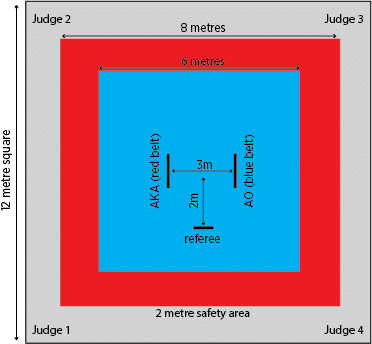
Scoring in Karate competitions is relatively simple. Scoring is limited to the following areas of the opponent’s body:
- Head
- Face
- Back-Neck
- Chest
- Abdomen
- Side
- Back
A score is awarded when one fighter performs a technique that conforms to the following criteria and the blow lands on a relevant scoring area of their opponent’s body:
- Good form
- Vigorous application
- Good timing
- Accurate distance
- Awareness
- Sporting attitude
Fighters can score one, two or three points for attacking techniques:
3-Ippon (three points) is awarded for:
- A jodan kick (kick to upper level)
- Any scoring technique performed on a fallen or thrown opponent
2-Waza-ari (two points) is awarded for:
- Chudan (mid level) kicks
1 -Yuko (one point) is awarded for:
- Chudan or Jodan Tsuki (mid or upper level punch)
There are three degrees of warning; CHUKOKU, KEIKOKU and HANSOKU CHUI.
Rules of Karate
- Karate Kumite matches take place on a matted square of 8m x 8m with an additional 1m on all sides that is called the safety area.
- Once the referee and judges have taken their places, competitors should exchange bows.
- The fight starts when the referee shouts “SHOBU HAJIME!”
- Both fighters should attempt scoring techniques (punches, kicks and throws) on their opponent. These are classified as Yuko, Waza-ari and Ippon and are one, two and three points respectively.
- If the referee deems a scoring technique may have been used, the referee shouts YAME and the contestants, judges and referee all resume their original positions.
- The judges will then indicate their opinion by means of a signal and if a score is to be awarded, the referee identifies the contents and the area that they attacked and then awards them the relevant socire (Yuko, Waza-ari or Ippon) and then restarts the bout by shouting “TSUZUKETE HAJIME!”


